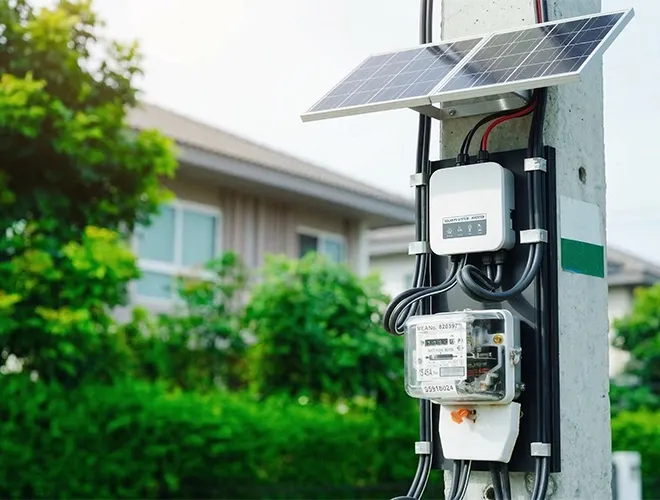
If you are looking into rooftop solar, you’ve likely heard the term 0 .While your neighbors might talk about solar panels, the Net Meter is actually the “Brain” that calculates your savings.
If you are in Erode, Salem, or anywhere in Tamil Nadu, understanding this small device is the difference between a system that pays for itself and one that wastes your energy.
Most homes have a Unidirectional (Normal) Meter. It is designed for a one-way street: power comes from the grid into your home, and the meter counts up.
The Problem: If you install solar with a normal meter, your excess power flows back to the grid for free, or worse, some old digital meters might actually charge you for the power you give away!
The Solution: The Bi-Directional Net Meter. Think of this as a two-way revolving door. It tracks:
In 2026, under the PM Surya Ghar Muft Bijli Yojana, the goal isn’t just to produce power; it’s to trade it smartly.
Example of the Net Metering Magic:
Instead of paying for 400 units, you only pay for 50 units plus the fixed service charges. This is how homeowners are effectively slashing their electricity bills by 90%.
A common question we get in Erode and Salem is: “I have two EB connections in the same building. Can I link them both to one solar plant?”
The short answer: No. TANGEDCO (TNEB) rules are very strict in 2026. A solar system must be tethered to a single Service Number (SC No). Trying to cross-connect wires between two different meters is not only illegal but can lead to heavy penalties and the cancellation of your solar subsidy.
If you have a high-consumption floor and a low-consumption floor, we recommend installing the solar system on the meter with the highest tariff slab to maximize your ROI.
Don’t let the “Red Tape” scare you. The process has been streamlined on the National Solar Portal, but it still requires precision:
Commissioning: Your system officially starts “banking” units for you!
Everything you were too afraid to ask the EB official.
Not exactly. Think of the Net Meter like a savings account for units, not a salary. If you produce more than you use, those units are “stored” in the grid. At the end of your billing cycle, TANGEDCO subtracts your exports from your imports. If you’re still in the plus, those units usually roll over. You won’t get a paycheck, but seeing a “Zero” or “Minimum Charge” bill feels just as good.
This is the most common heartbreak in Erode and Salem! Standard Net Metering systems (On-Grid) shut down during a power cut. * Why? It’s a safety feature called “Anti-Islanding.” It prevents your panels from sending electricity back into the lines while a lineman might be working on them.
Your Net Meter is a long-term player. While a heavy monsoon day in Tamil Nadu might dip your production, our bright summers usually over-produce enough to cover the gap. The “Net” in Net Metering looks at your total monthly or bi-monthly usage, so one rainy Tuesday won’t ruin your 90% savings goal.
Don’t wait, but do plan. It’s much easier to install a slightly larger inverter now than to replace the whole “brain” of your system later. Tell your installer about your expansion plans so they can “future-proof” your Net Metering application and structure.
It used to be a headache, but in 2026, the National Solar Portal has made it much faster. The “bottleneck” is usually just the physical availability of the meter or the inspection schedule. As long as your wiring and earthing are done perfectly (no shortcuts!), the approval usually sails through.
Unfortunately, no. The banked units are tied to the Service Number (SC No), not the person. If you sell your house, the new owner gets the benefit of those “stored” units. It’s a great selling point for your property value, though!





Let’s power your future together.

Asian Power Tech is a TNEB-licensed solar and electrical solution company based in Salem, Tamil Nadu
206, Ambalavanaswamy Koil Street, Gugai,
Salem – 636006,
Tamil Nadu, India
© 2025 Asian Power Tech. All Rights Reserved.